The Lost Theatres of Edinburgh
156 days ago
Written for the inaugural William Anderson Memorial Competition
Edinburgh - City of Celebration
The Lost Theatres of Edinburgh
Edinburgh is a city that celebrates the arts more than most, richly earning its reputation as the world’s leading festival city. Its year-round festivals and numerous theatres and concert halls provide an extraordinary variety of entertainment in the form of music, comedy, drama, spectacle and more. Although the city’s involvement in performance arts goes back hundreds of years, most of today’s theatres are relatively new. The oldest is the Royal Lyceum, opened in 1883 by theatrical impresarios Howard and Wyndham, while the first in a series of entertainment venues was built on the Festival Theatre site over two hundred years ago, and there have been circuses and theatres there continuously ever since.
The first purpose-built theatre in Edinburgh was built in 1736 by Allan Ramsay in Carrubber’s Close. Closed by magistrates within a year, its short existence is acknowledged by a bronze plaque. A similar plaque further down the High Street marks the site of the Canongate Theatre, built in 1746 and famous for staging the first performance of Home’s Douglas. Anyone walking the streets of Edinburgh hoping to continue tracing its theatrical history would come unstuck after that, until the opening of the Royal Lyceum, because the capital’s two most important 19th century theatres have disappeared without a trace.
Waverley Gate, on the corner of Waterloo Place and the North Bridge, is now a prestigious office complex built inside the shell of the former General Post Office. This great civic building opened in 1866, but the fact that Scotland’s first Theatre Royal was bought by compulsory purchase and reduced to rubble in 1859 to make way for it isn’t widely known. There is nothing to mark the site. Neither is there any indication of the existence of a series of magnificent theatres built beside St Mary’s church at the top of Broughton Street.
*
Edinburgh was the first place outside London to be granted a royal patent for theatre. Charles II had awarded royal patents to Drury Lane and Covent Garden in 1660, bringing to an end the banning of theatres under Puritan rule, but after a hundred more years only one other had been granted, to London’s Haymarket. The awarding of a patent outside the capital in 1767 caused great excitement in the world of British theatre, meaning leading players could come to Scotland and perform legitimately for the first time. Although more patents soon followed - for Bath, Liverpool, Manchester and Bristol - no more were granted in Scotland until Glasgow’s Dunlop Street Theatre received one at the turn of that century.
A consortium of gentlemen obtained Edinburgh’s royal patent in a controversially secret negotiation, and when a principle actor from Covent Garden, David Ross, approached them to buy it they quickly struck a deal. Ross took on the lease of the Canongate Theatre, which had been almost destroyed by riots and was in a sorry state, and set about repairing it at once.
He opened later the same year on December 9th, making The Earl of Essex the first legitimately performed play in Scotland. The novelty of watching plays performed by royal permission was enough to deliver a successful opening night and carry Ross through his first season, but interest soon waned, and after a year of operating in the patched-up Canongate he began to think the future lay to the north, where excitement was building for a new town. Ross decided to build a new theatre and bought part of a field from the Orphans’ Hospital, beside the bridge being constructed over the Nor’ Loch. This field had been used for many years by the preacher, George Whitfield, and when Whitfield visited that summer he was so incensed to find a ‘devil’s house’ under construction he had to be restrained from setting fire to it!
Ross paid six thousand pounds to buy the land and build the theatre, as well as a thousand guineas to pay off the proprietors of the Canongate. He raised the money by selling hundred pounds shares for free entry and three per cent interest. It was a simple building, described by someone at the time as ‘of a barn-like appearance, with a front just sufficiently ornamented to indicate that the designer had seen in his boyhood, or imagined in his dreams, something more elegant than a dead wall perforated with doors.’ On the apex of the roof was a statue of Shakespeare, and on each side the Tragic and Comic muses. Capacity was about six hundred and fifty - not much more than the Canongate - but over the years it was developed to accommodate fifteen hundred.
The new Theatre Royal was ready to open in November 1769, but, tragically, a section of the North Bridge collapsed with the loss of five lives, and the opening was delayed until December 9th, two years to the day since The Earl of Essex had ushered legitimate theatre into Scotland. This time Ross opened with a popular comedy, The Conscious Lovers. It would be three more years before the bridge was ready, so people had to make their way from the High Street down Leith Wynd and Halkerston’s Wynd that bitterly cold night, and hot cinders were thrown onto the steep slopes so sedan chair carriers wouldn’t slip and fall. The following week Ross starred in The Beaux Stratagem, but the season was a failure and he soon made over the lease to a well-known one-legged comedian called Samuel Foote. Foote brought his entire Haymarket company to Edinburgh that winter and was very well received, but he paid his company so well and lived so extravagantly that he was soon in financial difficulty and made over the remainder of his three-year lease to a Mr Digges.
Over the following years new managers took on the Theatre Royal with varying degrees of success, putting on a mixture of London plays and farces, comic operas and Shakespeare productions, swinging precariously between success and failure. It was only after the third patent was granted in 1809 to Henry Siddons, son of Sarah Siddons, the famous London tragedian whose performances had provided some of Edinburgh’s best audiences, that the seeds for a brighter future were sown.
1815 not only saw the end of the Napoleonic wars but also the death of Henry Siddons. His widow, Harriot, became the royal patent holder and inherited a huge debt. She soon realised how much more difficult the realities of the aftermath of the war were for people to bear, though, and decided they needed lifting out of the harshness of reality more than ever; they needed an excuse to gather and celebrate, to lose themselves in stories, comedy and music; they needed theatre. Harriot appointed her younger brother, William Murray, as her manager, and together they faced the financial challenges and made improvements both to the venue and to the overall theatrical experience, which had traditionally been so rowdy that actors could hardly be heard. Meanwhile Walter Scott, the famous poet, advocate and theatre enthusiast, began writing novels incognito which were adapted into a musical plays and performed to great acclaim. When a third element was added to this happy alliance in the form of comedian Charles Mackay, the stars aligned and his performance in the play Rob Roy ignited a blaze of new Scottish national drama that burned brightly for decades.
During this golden era William Murray refurbished the building extensively several times, doubling its capacity, removing the statues and replacing Shakespeare with a chimney. When he retired in 1850 the theatre went downhill, though, and before long the council decided to purchase the site. The Theatre Royal’s final production was on May 5th, 1859. A packed house enjoyed songs and skits from performers old and new, and Robert Wyndham, the current manager, surprised them all by ending the night on a positive note. He was also manager of Edinburgh’s second theatre in Broughton Street and had decided to move his company there and rename it the Theatre Royal.
*
The Broughton Street theatre, where unlicensed performances had been produced for decades, had a far more colourful and dramatic history than the theatre in Shakespeare Square. Built in the round as a circus in 1788 by an equestrian performer and a circus proprietor, Jones and Parker’s Circus was connected to both Sadler’s Wells and the Royal Circus in London, and performers and repertoire were regularly moved between venues. Against the backdrop of the Napoleonic wars, they presented elaborate spectacles of battles and sieges with horses and acrobats for rowdy audiences at a cheaper rate than the licenced theatre, using songs and banners to circumvent the prohibition of the spoken word in an unlicensed venue.
The London actor, Stephen Kemble, renamed it The New Theatre during his brief period of management in 1792, and when he left to take on the lease of the Theatre Royal it was renamed the Sadler's Wells Theatre. Throughout the following decade it was variously known as the New Theatre Circus, the Amphitheatre Circus, Jones’s Circus, Jones’s Royal Circus, and The Royal Circus. Then, on January 14th, 1803, it was reopened with a grand ball after being transformed into a concert hall. Corri’s Concert Rooms continued to operate there for twenty years, apart from a brief interlude when Henry Siddons used it while refurbishing the dilapidated Shakespeare Square building.
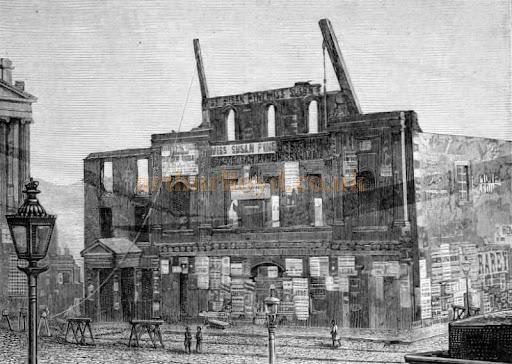
In 1823 The Pantheon, as the concert hall had become known, was transformed back into a theatre and renamed The Caledonian. Its new manager, actor Henry Erskine Johnson, started putting on productions in competition with the Theatre Royal, flouting the patent rules and charging lower prices, and this rivalry continued throughout the next forty years under different managers. Known as the Adelphi by the 1850s, it burnt to the ground in 1853 under the management of Robert Wyndham. His wife and new born son, Fred, (who later built the Royal Lyceum with John Howard) had to be rescued from their top floor rooms. Wyndham rebuilt it bigger and better and called it the Queen’s Theatre and Opera House, but, tragically, it burned down again ten years later with the loss of several lives. Known as the Theatre Royal by then, it was rebuilt in record time, only to burn down yet again another ten years later. The magnificent fourth incarnation of this beleaguered theatre opened in 1876, by which time Wyndham had retired, but a fifth fire destroyed much of it in 1946. It was demolished a few years later and St Mary’s church bought the site to build an extension and a bookshop.
It would certainly be cause for celebration if the enormous cultural contribution of Edinburgh’s lost theatres were ever recognised with the commemorative signs they so richly deserve.