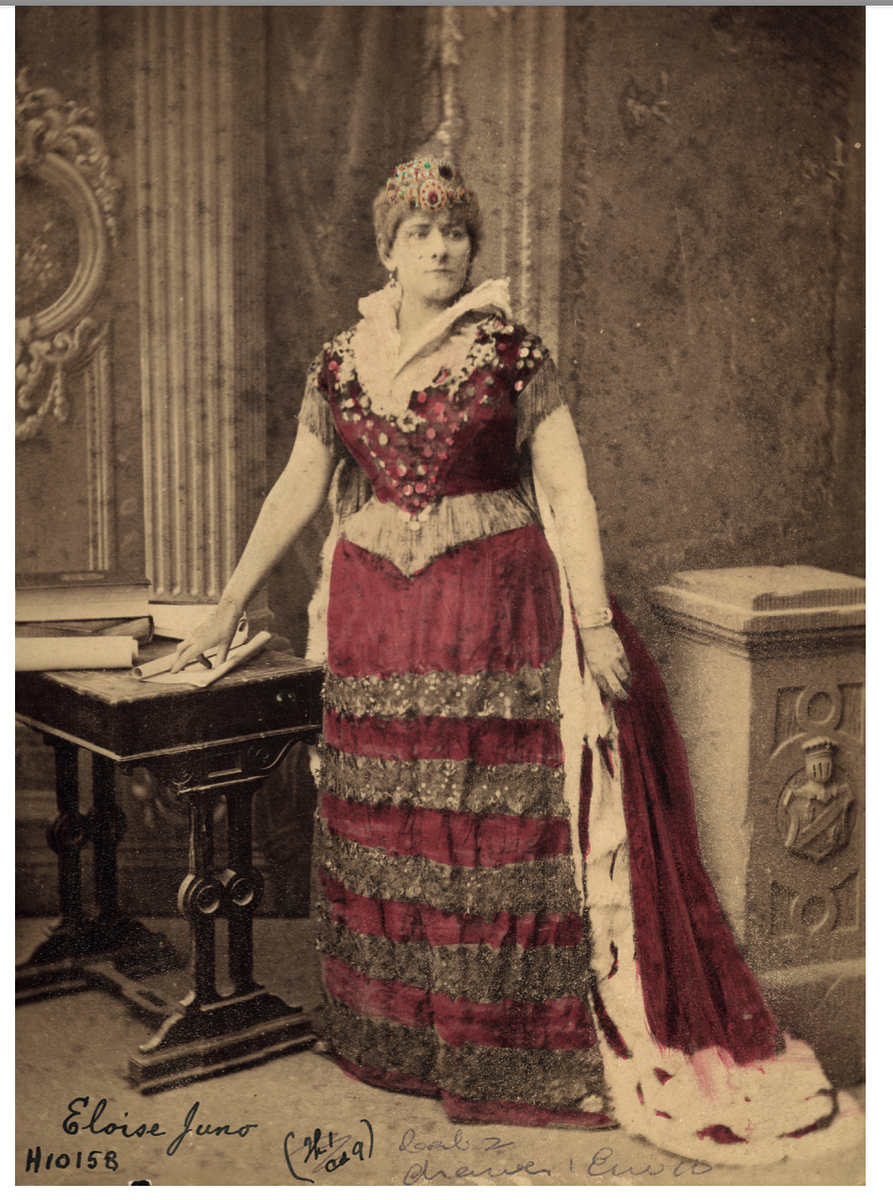
ELOISE JUNO: Longniddry's Victorian Superstar
58 days ago
Eloise Juno, born in Longniddry in 1840, was a hugely successful and famous actress who starred on the stage in Australia and New Zealand, as well in London’s Drury Lane and all the main theatres the length and breadth of Britain and Ireland. Popular both for her comedic performances and her tragic portrayals in Shakespeare – as well as everything else in between - this extraordinary woman died in 1923 in a retirement village in Australia where her incredible life and enormous achievements are still celebrated today.
Eloise first came to my attention when I was researching my novel Disappearing Acts: The Real Mackay’s Granddaughter. I had almost given up hope that my ancestor, the main character called Lottie Burles, had realised her dreams of the stage in the face of all the family difficulties and traumas I was finding, when I discovered her name in a newspaper advertisement for a production in Belfast starring Eloise Juno. I was delighted! Lottie had a decent stage career after all! Then I began looking for her name in all the advertisements for Eloise Juno’s UK Theatre company, and I found Lottie listed several times.
In order to write all this into my novel I needed to establish how these two actresses might have met. The most obvious answer, and the one I chose to use, was that Lottie and Eloise met as children in Edinburgh under the tutelage of Mrs Wyndham, who was well known for training children in ballet and acting for the Theatre Royal’s famous pantomimes. Once I’d found evidence that Eloise was, indeed, trained by Rosana Wyndham, I introduced her into the novel as a side character quite near the beginning of the book, giving her a simplified backstory, living as a child with her family in Longniddry, where she was born. The reason I knew where she was born was because her obituary, published on 16th April 1923 in the Australian newspaper, The Argus, mentioned it. This obituary was one of only two articles I could find about Eloise’s life at that time, and I was unable to verify her East Lothian origins with any primary sources, like birth records or census returns.
I continued my research into the story of Lottie touring Scotland and Ireland with Eloise’s theatre company in the 1870s, and I was blown away by the sheer grit and determination Eloise showed, by her extraordinary confidence, her adventurous determination, perseverance and self-belief. In fact, I almost stopped right there and started writing a book about Eloise Juno instead!
Then I came across an article about a contemporary Australian actress called Lois Collinder - known for her roles in Prisoner Cell Block H and Neighbours – who had recently moved into Rushall Park, the Australian retirement village where Eloise had ended her days. Lois had researched Eloise’s life, too, in order to give a presentation to residents about it at their 150th anniversary garden party in 2019. Of course I contacted her at once, and we’ve exchanged several emails since then. Lois wrote:
‘Celebrated Melbourne actress Eloise Juno must have been a formidable person, not just on the stage but also in her private life. Born in Scotland in 1840 Eloise had already established a reputation on the stage by the time she arrived in the colony, having debuted in a production of Oliver, in Edinburgh, in her teens.’
In her article Lois told me she reckoned she would have liked Eloise, who is still greatly loved and referred to her as their idol by the residents of Rushall Park retirement home. ‘Imagine that’, Lois said, ‘a young woman travelling alone around the world performing and building up a successful career at a time when women simply didn’t do that.’ I promised I’d send Lois a copy of Disappearing Actswhen it was finished, which I’ve now done, and she’s delighted.
It bothered me that I hadn’t been able to back up Eloise’s birth in Longniddry with documentary evidence, though. However, after my novel had been sent to the publisher, I had a chance conversation with a distant cousin, Alison, who’s an amazing genealogist and a very determined researcher. It wasn’t long before she’d found Eloise was born with a different name and thus found the proof I’d been looking for. Once Alison had verified Eloise’s birth name, the story of her troubled childhood emerged, a story far from the straightforward family picture I had painted in my novel.
Born Elizabeth Broadfoot on May 7th 1840, in Longniddry, in the parish of Gladsmuir, she was baptised on June 7th by the Rev Mr Ramsay. Elizabeth Boradfoot's parents were Walter, a teacher, and his wife Elizabeth Bayne. This was Walter’s second marriage, his first wife having died of influenza in 1833, leaving him with three young children. Two years later he married Elizabeth Bayne, a shoemaker’s daughter from Alnwick, and they had two more surviving children: James, and his younger sister, Elizabeth, who went by the name of Bessie. This was Eloise.
By the time of the 1851 census, however, James and Bessie (now 13 and 11) were lodging in Rose Street in Edinburgh, with a widow - described as a straw bonnet maker and a pauper - and her three children. Also at that address was a commercial clerk called William Junor. On further investigation it turned out that William Junor had married James and Bessie’s widowed mother in 1846, which was probably when they took their step-father’s name. This goes some of the way towards explaining how Bessie Broadfoot became Eloise Juno. The mystery of what had happened to their mother has not been solved, though. After this marriage she simply disappears from the record. It would seem that Bessie and her brother, James, were left to find their own way in life, with perhaps some support from the step-father whose name they’d taken.
In the early 1850s, whether with the help of her step-father or some other mentor, or by her own initiative, Bessie Junor started taking lessons in ballet and acting with the well-known children’s coach, Mrs Rosina Wydnham, as I mentioned earlier.Rosina’s husband, Robert, was manager of Edinburgh’s second theatre, the Adelphi, at that time.
As an aside, it’s interesting to note that the Wyndham’s son, Freddie, almost died in a fire that burnt the Adelphi Theatre to the ground, in 1853, shortly after Bessie would have started her lessons there. Just a few days old, Freddie was with his mother in the rooms above the theatre where the Wyndham family lived. After a dramatic rescue, his parents gave him the second name of Phoenix to remember his brush with death, and Freddie Phoenix Wyndham went on to found the hugely popular and well-known theatrical business Howard and Wyndham with his friend John Howard. Their first enterprise together was building and launching Edinburgh’s Lyceum Theatre in 1883, which still stands to this day. I’ve included various references to this story in my novel, Disappearing Acts, and an article about it is published on my website.
Robert Wyndham took over the vacant Theatre Royal in Shakespeare Square immediately after the fire, while a new theatre was being built on the site of the Adelphi, and it was here, in the Theatre Royal, that Bessie soon became a favourite of the Wyndhams, her talent marking her out for a successful career on the stage at once. Bessie was just shy of 14 when she was deemed to have had enough experience on stage to begin as an actress in her own right. The importance of this coaching from Mrs Wyndham and the opportunities the Wyndhams provided for Bessie in these Edinburgh theatres cannot be emphasised enough in terms of launching this orphaned child into what became and international stage career.
Bessie’s first major role was that of Rose Mayley in Oliver Twist in March 1854. Taking part in this production not only garnered great reviews, the press predicting a splendid career for her, it was also the first moment her talent for comedy was revealed by a well-known London comedian called Mr John Lawrence Toole, who played the Dodger. Such was his fame that a new song had been written especially for him, called The Dodger’s Lament. Widely regarded as one of the brightest, most genial and warm-hearted actors of the time, Edinburgh audiences knew good acting when they saw it and 19th century theatrical historian James Dibdin wrote that ‘it is questionable if any actor – even Mackay himself - was ever so much liked by an Edinburgh audience as Toole.’
Charles Mackay, known to his adoring public as The Real Mackay, was my ancestor and the subject of my first novel by that name and Walter Scott’s favourite comedian. He retired from the stage in the spring of 1853, due to ill health, and Toole arrived from London shortly after, most probably to take his place. I like to think Charles Mackay might have attended this production of Oliver and enjoyed Toole’s antics with Bessie Junor.
‘There’s only one problem with my talented young protégé, Mr Toole,’ Mrs Wyndham said when commending Bessie to Toole. ‘For some unknown reason, she cannot not be made to laugh!’ Now it would hardly be surprising if Bessie had been quite an earnest and serious girl at this stage in her young life. She was, after all, trying to begin a career on the stage with little or no support from family. ‘Oh,’ Toole replied at once, ‘I’ll settle that. She’ll laugh so that she’ll not be able to get a word out!’ After the first scene was over on the opening night Toole stepped into a private box to watch the young actress. The moment he caught her eye he made such an extraordinary grimace that she burst into a peal of laughter and, as he’d prophesied, she couldn’t get a word out. I imagine she was still standing there, laughing helplessly, when Sir William Don of Newton Don – known as the eccentric baronet - came on stage to rescue the moment. Don’s particular speciality was to walk over all the chairs on the stage, and over the performers too, when they were seated. I imagine Bessie was unable to recover her composure for quite some time! In future years Bessie became known as Scotland’s foremost comedienne, but the opening night of that production of Oliver in Edinburgh’s Theatre Royal in 1854 was not only her stage debut, but the first time she’d participated in a comedy act.
Bessie’s first Shakespearean role was that of Regan in King Lear, alongside the celebrated actor, Charles Dillon. It was during this time in Edinburgh, too, that she performed alongside the great tragedian, Sir Henry Irving (the first actor ever to be knighted). During his early years on the stage, Irving was another protégé of the Wyndhams. Not only did he have to leave a difficult family situation to begin his stage career, but he also had a terrible stutter. Born as John Brodribb, had adopted his stage name during those early years under the Wyndhams, who helped him improve his elocution enormously. In fact, it is very likely that Irving’s gratitude for all the Wyndhams had done for him influenced his decision, in 1883, to divert his hugely successful London Lyceum Theatre company to Edinburgh on their way to tour the United States in order to open Freddie Phoenix Wyndham’s newly built Royal Lyceum theatre with a production of Much Ado About Nothing, in which he starred alongside rising star Ellen Terry. But that is another story, as I mentioned before.
Although various newspaper reports from the late nineteenth century say that Eloise Juno moved with her parents to New Zealand, and that is what I wrote in my novel. I now know that both her parents were dead by then and that she forged her entire career by herself.
Eloise, still known as Bessie, branched out from Wyndham’s Theatre Royal and began performing in other Scottish theatres, appearing on playbills with excellent reviews in Dundee, Renfrew and Glasgow when she was still in her teenage years. One notable Edinburgh performance happened in December 1861, when Eloise was twenty-one, at William Howard’s Operetta House at 23 Waterloo Place. It had just been acquired as a theatre, having previously been Edinburgh’s first large, purpose-built hotel, The Waterloo. The auditorium of the Operetta Housewas upstairs in what had been a dining room. It was a long room, with Ionic columns, not very wide, and with a semi-circle of raised seats at the back. It had a small stage – where dioramas, and a variety of concerts of all kinds were produced. The Operetta House was billed as a family house, meaning, anything of an objectionable nature on the stage was discouraged. Here, Bessie supported Miss Julia St George, a popular British actress and vocalist renowned for her roles in fairy extravaganzas, including performances at the Prince's Theatre Royal. Celebrated for a ‘rich voice’ and grace, St George was described as ‘a perfect dream of loveliness’. Apparently, she was also known for selecting her costumes on the rather dubious principle that ‘and actress must please the eye before she can reach the heart.’
It was during this period in Eloise’s burgeoning career, that a slip on the part of a prompter when making out the playbills changed her surname to Juno. When the stage manager saw it, the story goes that he thought the shorter name looked so fine in print he insisted on keeping it that way, changing Bessie, or Elizabeth, to Eloise for good measure. After that she is much easier to trace as there are so many newspaper articles and theatrical advertisements that mention her over the five decades of her hugely successful career.
Another amusing incident occurred, during this early period, in Glasgow’s Gaiety Theatre. The manager, Charles Barnard, had engaged Eloise to play Meg Merrilees in Guy Mannering. Meg had an important moment at the close of the second act, and Eloise, waiting for her cue, was drawn into a conversation with one of the other actors. Suddenly she heard the curtain descending and, hurrying down, she met the little call boy who said in a very solemn manner, ‘The curtain’s doon, an’it’s a’ ower, an’ I wadna like tae be ye!’
And yet another anecdote tells of an amusing slip up when Eloise was engaged in Dundee for a season and the bill was changed at the last minute to Romeo and Juliet. Unfortunately, it was discovered during rehearsal that the actresses cast as Juliet and her nurse had left the city. Eloise was only given a moment’s notice to play the nurse and she got along fairly well until the important scene with Juliet, when everything came to a standstill. After a long silence she exclaimed, with scant understanding of the play,‘There, Juliet, there! If you can’t marry the one, you must marry the other!’ The remainder of the scene could not be heard for the laughter of the audience.
In her early twenties Eloise began to turn her attention to New Zealand where some of her professional friends were winning even more fame than she had found in Scotland. Once she’d saved enough for passage, no doubt helped by some special benefits put on for her, such as this one in Renfrew in January 1863, she set sail to join her friends to seek greater opportunities on the stage on the other side of the world. Eloise was twenty-three when she set out on this huge adventure - although I haven’t yet found her on a passenger list. She arrived in Dunedin in 1864 after over 100 days at sea. No doubt she connected with those professional friends as soon as she could, and lost no time in introducing herself to the successful British actor/manager Mr Clarence Holt.
Holt had only recently moved to Dunedin himself, after managing the Theatre Royal in Melbourne. He’d recently set up his own theatre and was about to commence a Shakespeare season. ‘Very sorry, Miss Juno,’ he replied to her request for work, ‘but my list is full; if you’d like to play a week without a salary, just to let me see what you can do, I may be able to offer you something later on.’ She accepted his offer and played supporting roles for a week, at the end of which she watched all the other members of the company going into the office to receive their salaries with a heavy heart, listening to them joking about the hardness of the times they were in. Then Mr Clarence Holt came out and called her aside.
‘I’m very satisfied with the way you’ve worked,’ was all he said as he dropped a tiny envelope in her hand. Much to her delight, it contained a ten-pound note. Apparently, Holt had been struck with the great sweetness, clearness of enunciation and delicate light and shade with which she performed, and had decided to engage her in his company at once. She was soon playing Ophelia and other leading roles, earning glowing reviews both from the public and the press. Her great hit during that first season was as Maggie MacFarlane in The Bonnie Fishwife. Her success in this part was extraordinary, and attracted the attention of Mr George Fawcett Rowe, who offered her an engagement to star in a touring company he was forming to travel round New Zealand.
Never one to balk at adventure, Eloise accepted. Fawcett’s company visited all the principle cities in New Zealand, with plenty of dramatic moments in the course of their journeys, especially on the west coast where the troupe often came close to being ship-wrecked. The New Zealand tour concluded at the old Prince of Wales Theatre in Auckland with Mr Harry Edwards, another well-known British actor, as the star. After that Eloise played a season of twenty months in Auckland, with wonderful success. Her best character was always Maggie MacFarlane in the one act comedietta, The Bonnie Fishwife, and before long she was being advertised on playbills as ‘the celebrated comedienne’.
Her fame had, by this time, reached Australia, and Mr George Coppin, manager of the Theatre Royal in Melbourne, offered her an engagement to support the celebrated French actress and dancer, Madame Celeste. It is very likely Eloise had first encountered this extraordinary actress at the outset of her career in the Theatre Royal, Edinburgh, as they were there at the same time.
On May 21st 1869 Eloise Juno was given a benefit night in Auckland under the patronage of the governor of South Australia - soon to be governor of New Zealand - Sir James Fergusson, and his wife, Lady Edith. The pieces chosen wereThe Green Bushes, a selection from The Heart of Midlothian, and the ever-popular Bonnie Fishwife. It was time to leave New Zealand for pastures new.
Eloise travelled to Melbourne in 1869, where she supported Madame Celeste, as promised. This celebrated and fascinating actress was known for embodying characters of non-European origin who 'crossed the boundaries of both gender and ethnicity’.
In Melbourne Eloise played Starlight Bess in Flowers of the Forest, and other secondary roles, with great success, and was given, once again, the leading role in The Bonnie Fishwife for 32 nights, her performances hailed every night by large audiences with exclamations of delight. Based in Melbourne, she became the star of the theatre, and continued as such for seven glorious years, during which she was invited to perform in the foremost theatres in Australia’s principle cities with many other notable actors on their world tours, such as the hugely popular British comedian and impersonator, Charles Matthews.
Here’s an extract from an 1889 issue of a Melbourne publication called Table Talk:
Among Miss Juno’s remininscences, the burning of the old Theatre Royal, Melbourne, stands out with fearful distinctness, the more so as she was engaged in the performance - The Streets of New York—and lost a large portion of her wardrobe in the conflagration, like almost every other member of the company; for, although there had been prophecies innumerable that the fire scene in the play would set the theatre aflame, nobody was prepared for the catastrophe.
By the early 1870s Eloise sensed her time in Australia was drawing to a close and was longing to make her mark on the London stage. It was time for another epic voyage. A complimentary benefit was laid on for her in Melbourne, gathering one of the largest audiences ever known in Victoria to greet her on what was known to be her final appearance in the colonies, prior to her departure for England. During the evening a magnificent gold watch was presented to her, and Eloise was created life-governor of the Dramatic Authors’ Association. She set sail from Victoria in 1874 on a vessel called The Yorkshire, under the captaincy of George Gibbs.
On arrival in London Eloise was quick to make theatrical connections, one of the most notable being with Madame Celeste, who welcomed her warmly, as did many other artistes of standing who knew and recognised her great ability. Indeed, Madame Celeste was so delighted to re-connect with Eloise in London that she took her at once to Mr Chatterton, the manager of Drury Lane and the Adelphi Theatre, explaining volubly and emphatically, ‘Dis is de only lady in de world who can play de Bony Fishwife!’
It appears Eloise was not in the best of health at first, though, according to an article that reports her health being ‘much better than it has been since she arrived in England.’ Perhaps the long voyage took a toll. Her first significant engagement was with Mr W. Holland, for a short season at the Surrey Theatre, where she appeared as Queen Gertrude in Hamlet and was a great success. Critics wrote in high terms of her ‘even and conscientious performance.’
An appearance was soon offered by the Drury Lane actor, William Creswick, for her to play Lady Macbeth, and the London press pronounced most favourably on this, her initial effort in London’s foremost theatre. Eloise went on from there to play the principle female roles in all the main Shakespeare plays in London with continuously excellent results. Perhaps she had grown used to touring in New Zealand and Australia, perhaps the vast distances she had covered there, the terrible travelling conditions, not to mention her epic voyages, made travelling by train around Britain seem relatively easy, because it wasn’t long before she was performing at Glasgow’s Theatre Royal and talking of putting together a theatrical company of her own to embark on an extended tour of Scotland, Ireland and England.
It is around this time I have re-introduced Eloise into my novel, imagining my main character, Lottie (The Real Mackay’s Granddaughter) reading in the theatrical publication The Era that Eloise was coming to Glasgow to perform in Heart of Midlothian and had plans to tour her own company. Of course, in reality, Lottie would have known her as Bessie Junor, so wouldn’t have made the connection. But I was unaware of that when I wrote the novel! So, I imagined Lottie writing to her in London, introducing herself as someone who had known her as a child, training together in Edinburgh with Mrs Wyndham. However it was they met, Lottie joined Juno’s Theatre Company and toured Scotland and Ireland with her in the 1870s, playing the best roles she ever played in what was, admittedly, a much more low-key, stage career.
In the following extract from Disappearing Acts Eloise invites Lottie to join her on tour and gives her the first major role she’s ever played, that of a child in a well-known American melodrama called Leah, The Forsaken.
‘We’re going to Dumfries at the beginning of June, Lottie, once I’ve finished my contract with Mr Creswick in Surrey. I wondered if you might care to join us again? Then it’ll be on to Aberdeen in July. Can you leave your girls with their nanny for a few days, d’you think?’
Eloise had a striking, squarish face and intense brown eyes topped by dark, straight eyebrows. She wore her abundant inky-black hair in a long plait down her back and crimped into short curls around her face. Her hilarious portrayal of Maggie Macfarlane in The Bonnie Fishwife had propelled her to fame in New Zealand, and she was terrifying as Lady Macbeth, too, according to her senior actress and greatest admirer, Mabel Tracey, who had joined Eloise in London and now seemed inseparable from her.‘
I’m sure they’d hardly miss me, Eloise!’ Lottie fiddled with her gloves, trying to make light of the question while her heart performed gymnastics inside her tight bodice.
‘You’ve been such a dear to work with, Lottie – I do hope I wouldn’t be stealing you from the Theatre Royal!’
‘Oh no, not at all – that is – I’m sure they could spare me for a few days!’
‘That’s settled, then! I’ll send some scripts round to your house in the morning – where is it you stay?’
‘Just leave them with Mr Cowie at the box office and I’ll pop in on my way home from taking the girls to school tomorrow morning.’ The last thing Lottie wanted was for Eloise to know where she lived and that the staff she’d referred to were actually her neighbours on the stair.
‘Perfect! We’ll be performing Heart again, of course, and this time I want to put on Leah, The Forsaken too. I love venting all that passion, Lottie, cursing at the top of my voice, terrifying the audience – it’s such fun, don’t you think?’
‘I haven’t seen it yet, but I’ll be sure to read the script at once.Do you have a part in mind for me?’
‘I have you down for the child, Lottie, as you are quite slight. I’ll leave a travel itinerary for you with the scripts.’
For the purposes of my novel, I concentrated my research on productions in which Lottie was listed on adverts. There are scores of adverts in the British Newspaper Archive to trawl through over the few years Eloise was in Britain, though, showing she took her theatrical company all over England, Scotland and Ireland more than once. On one occasion a performance at Glasgow nearly came to grief through the loss of luggage and wardrobe, but the Glovers, the well-known theatrical family of that city, came to Miss Juno's aid, lending her all she wanted. Some weeks after, her box was discovered quietly lying in a railway shed, and the authorities were quite amazed to hear the indignant lady threatening an action against them. Compensation, however, settled the difficulty.
It was in Belfast, during her second tour of Ireland, that Eloise produced and starred in the first ever performance of a play adapted from a new novel written by Frances Hodgson Burnett called That Lass o’ Lowrie. Burnett was a young British girl who’d emigrated to America with her mother at the age of sixteen. This was her first novel, a powerful story of love and suffering, class and injustice.
After almost seven years in Britain, Eloise set sail for Melbourne again on June 4th, 1881, on a Glasgow-built three-masted iron clipper called the Loch Garry. On the passenger list she is recorded as being thirty-eight, although she would have been at least forty by then. Accompanying her was the actress, Mabel Tracy, who was listed as being twenty-four and seems to have been her closest and most loyal companion. Eloise never married, nor have I found any mention of romantic attachments in all the articles I’ve read about her.
A woman with ambition and talent, Eloise had soon put together her own dramatic company and was touring Australia and New Zealand again. Still best known for The Bonnie Fishwife she was also famed for her role as Helen McGregor in Rob Roy. Eloise was nothing if not adaptable, competent in all the roles she played, whether performing in musicals and farces, or in Shakespeare, most notably as Lady MacBeth, Cleopatra, or Beatrice in Much Ado About Nothing. The following extract is from a Tasmanian daily broadsheet called The Mercury, January 17th 1883, shortly after her return.
"A magnificent impersonation was that of Leah, the Forsaken, by Miss Eloise Juno, at the Theatre Royal, Hobart, last night. The character of the unfortunate Jewess affords grand scope for histrionic genius and art, and Miss Juno gave evidence of her dramatic powers that recalled to mind some of her most brilliant triumphs of past years, and satisfied the admirers of this talented actress that she is still as capable as ever of rising to the heights she had attained. Alike in the beauty and happiness of the Jewish maiden's passionate love, in the rise of her cruel disappointment, in the intensity of her black despair, the bitterness of her hatred, the awfulness of her revenge, she was great; and in those last scenes in which hatred and revenge loose their hold upon the heart, and penitence, womanly tenderness, and love, fill it till it breaks in gentle death, after the outpouring of the fury of her indignation and denunciation upon the apostate Nathan. She " mirrored Nature " in its subtlest and most powerful phases, and that is the highest praise a critic can bestow."
Despite her fame and popularity, Eloise never made a fortune. She retired from the stage in the late 1890s and taught elocution and dramatic arts at Miss Jennie Brenan’s School of Society and Theatrical Dancing at Scourfield Chambers in Collins Street, Melbourne, for quite a few years. Owing to ill-health she was obliged to discontinue her tuition and in September, 1910, and that was when she moved into the Rushall Park Old Colonists’ Home to retire. This caring community for retired actors and others in need had been founded in 1869 by Eloise’s fellow thespian and former theatrical manager, George Coppin, the man generally considered to have been the father of Australian theatre.
Eloise lived for 13 years in Hearn Cottage, built by Mr and Mrs James Hearn and endowed to the retirement home by John Traill, and was much loved by all at the retirement village, who considered her to be their idol. She ended her days at the Old Colonists’ Home in April 1923, shortly before her 83rd birthday. Her funeral was a sign of the impact she had made at the village, with pallbearers including the President of the Old Colonists Association, Mr James Grice, and the incredible Victorian Superstar from Longniddry is still celebrated at Rushall Park to this day.